Change and communication leader Dr. Aniisu K. Verghese, who faced racism, ageism, and discrimination across his own global career, launches Empowering Employability to support migrant professionals navigating the Australian workplace, and to confront an underemployment crisis costing Australia AUD9 billion a year.
SYDNEY, AUSTRALIA. Change and communication leader, author, speaker, and trainer Dr. Aniisu K. Verghese has launched Empowering Employability, a three-course series on Udemy built for skilled migrants and international professionals working to establish or advance their careers in Australia. The series is drawn from more than 25 years of leadership experience across India, Poland, the United Kingdom, Bangladesh, and Australia, and from a career that has repeatedly put him face to face with the quieter, harder-to-name barriers migrants encounter: racism, ageism, and discrimination dressed up as ‘cultural fit’.
Asked to change his name. Asked to hide his PhD
Dr. Verghese’s career has taken him across five countries and some of the world’s most recognised organisations. In each market, he has met a different version of the same message: that being qualified and being accepted are not the same thing.
In one geography, he was told his name was too difficult and encouraged to adopt something easier for colleagues to pronounce, a request to trade identity for convenience. In another, he was advised to leave his doctorate off his CV and correspondence, because being visibly overqualified made him seem like a threat rather than an asset. Alongside these moments sat the more familiar patterns of ageism and discrimination that many experienced, capable professionals encounter once they cross a border: being read as ‘too senior’, ‘too foreign’, or simply ‘not quite the right fit’, regardless of the results on the page.
None of this happened because Dr. Verghese lacked capability. It happened despite three published books, senior global leadership roles, and industry recognition including speaking at international forums on four continents and the International Association of Business Communicators’ APAC Communicator of the Year. That contradiction, credentials meeting a system unwilling to make room for them, is what he now puts at the centre of his work.
A navigation gap costing Australia billions
Australia is one of the most migrant-rich nations in the world. Roughly one in four Australians was born overseas, and the country consistently ranks in the top 10 globally for economy, healthcare, and quality of life. Yet for many skilled migrants, arriving with strong qualifications and deep experience is not enough to secure work that matches their expertise.
Research from Settlement Services International (SSI) and Deloitte Access Economics found that 621,000 permanent migrants in Australia are working below their skill level, including 372,000 who arrived through skilled migration pathways specifically because Australia needed their expertise. The resulting skills mismatch, around 44 percent, is estimated to cost the Australian economy $9 billion every year in lost productivity. Separately, the Grattan Institute has found that around 25 percent of skilled migrants are underemployed, a gap it attributes not to capability but to unfamiliarity with local workplace culture, hiring practices, and professional norms.
For a country that depends on skilled migration to fill critical workforce gaps, the cost of asking newcomers to shrink themselves to be accepted is not just personal. It is economic, and it is avoidable.
Race, gender, and age: barriers the research keeps confirming
The barriers are not limited to accent or unfamiliarity with local norms. A study by Monash Business School and King’s College London found that job applicants with non-English or ethnic names receive up to 57 percent fewer positive responses than applicants with English names when applying for leadership roles, despite submitting identical resumes (Monash Business School). A separate Monash University study found that migrant women often face intersecting discrimination, including wage disparities, social exclusion, and restricted career progression, shaped by the combination of their gender, race, and religion. To address this hidden systemic inequality, the Australian Human Rights Commission has been pursuing a national inquiry into racism in Australian workplaces.
Age compounds the problem. As many as a third of older workers report experiencing age discrimination at work, and many employers openly admit a reluctance to hire people over the age of 50. Even amid widespread skills shortages, one in six Australian organisations say they will not consider hiring candidates aged 65 and over, according to a survey by the Australian Human Rights Commission and the Australian HR Institute. For migrants who are also older professionals, these barriers do not sit side by side. They stack.
The Empowering Employability series
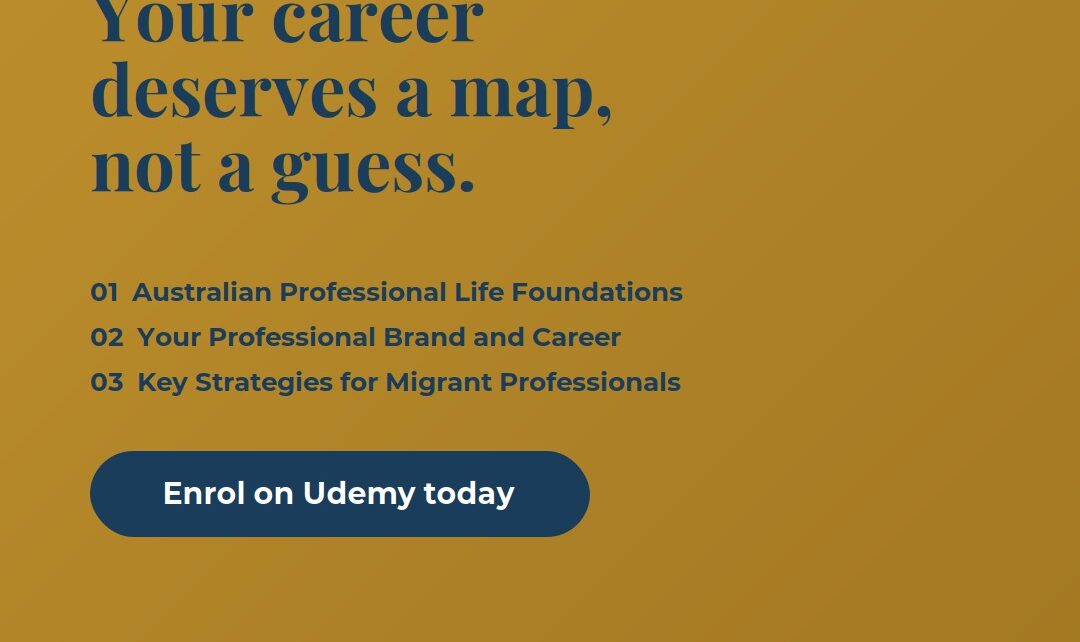
Rather than generic career advice, the series translates lived experience into a structured, practical curriculum. It is available now on Udemy and comprises three progressive courses:
Course 1: Australian Professional Life Foundations
Decodes Australian workplace culture and the unwritten rules that govern it, covers resume and interview formats suited to the local market, and introduces the six professional archetypes migrants encounter while building a new network.
Course 2: Your Professional Brand and Career
Applies Dr. Verghese’s 3C Personal Branding Model, Clarity, Commitment, and Consistency, to help migrants rebuild professional visibility and reputation from zero, and shows how to frame a migration story as a career asset rather than a gap to explain, or an identity to hide.
Course 3: Key Strategies for Migrant Professionals
Addresses advanced and senior-level challenges, including executive presence, thought leadership, curiosity-first relationship building, and long-term career and legacy planning for migrant leaders.
I was asked to change my name so it would be easier for people to say. I was told to leave my PhD off my CV so I would not seem intimidating. Also, I was told to tear up my degrees and certificates and start from scratch. I have carried three published books, senior leadership roles, and industry recognition across five countries, and I have still been asked to make myself smaller to be accepted. Empowering Employability exists because no one should have to erase who they are to be given a fair chance.
Dr. Aniisu K. Verghese, Change and Communication Leader, Author, Speaker, and Trainer
An invitation to migrant forums, universities, and community leaders
Dr. Verghese is inviting three groups to help extend the reach of this work:
- Migrant community forums and networks are welcome to share the series with their members as a practical resource for navigating the Australian job market.
- Universities and online education providers offering courses to international students and new migrants are invited to include the Empowering Employability series within their curriculum or student support offerings.
- Student and alumni networks are invited to have Dr. Verghese address their communities directly, drawing on his own experience across five countries and the research behind the series.
Organisations interested in any of these partnerships can reach Dr. Verghese through the media contact details below.
About Dr. Aniisu K. Verghese
Dr. Aniisu K. Verghese is a change and communication leader, author, speaker, and trainer with more than 25 years of experience across India, Poland, the United Kingdom, Bangladesh, and Australia, including senior roles at organisations such as Tesco, Fidelity Investments, Sabre, and Accenture. He is an IABC APAC Communicator of the Year 2022, a LinkedIn Top Voice 2023, and a Prosci-certified change practitioner.
Dr. Verghese moved to Australia through the Global Talent Program, a visa pathway reserved for individuals recognised as leaders in their field internationally. He is the author of three published books, holds a PhD, and has spoken at events across four continents. Outside his professional work, he founded and ran Friends for Life, a global road safety charity and campaign, and he co-founded International Communication Professionals – Australia & New Zealand, a community that helps migrant communication professionals build a better understanding of the Australian market. He also runs one of the earliest and longest-running blogs on employee communications, Intraskope (www.aniisu.com), and hosts the GCC Voices interview series and the Internal Comms Insights newsletter.
Connect with him on LinkedIn: linkedin.com/in/aniisu