For the past several years, I have been working with and inside global capability centers – as a practitioner, as an advisor, and as someone who has watched what separates the centers that grow from the ones that quietly lose relevance.
One thing I did not find, in all that time, was a course built specifically for GCC change management and communications leaders. There are good change courses. There are good internal communications courses. There are employer branding programmes. But none of them account for the specific conditions that define GCC leadership: the political distance from HQ, the multi-cultural change environment, the need to build employer brand in markets where the global corporate name carries limited weight, and the challenge of making your value visible to a governance model that was designed for a different generation of center.
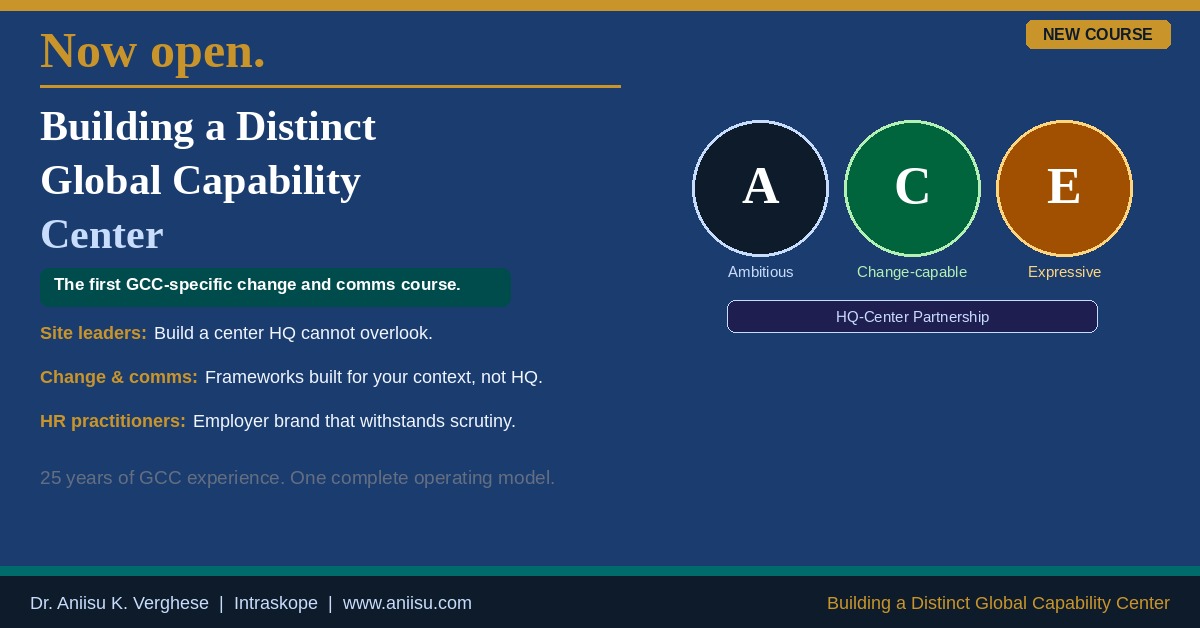
I built the ACE Framework to fill that gap. And today I am making it available as a course.
https://www.udemy.com/course/build-a-distinct-global-capability-center
What prompted this
Three patterns I kept seeing, regardless of geography, industry, or center size.
Change initiatives that failed not because the plan was wrong, but because the approach was borrowed from a headquarters playbook and applied without adjustment to a fundamentally different environment. Resistance that got labelled as culture when it was actually a design problem. Adoption that looked real at launch and had evaporated by month three.
Employer brand programmes that said the right things and attracted the wrong people — or no people — because they were built from aspiration rather than from what the experience of working there actually was.
Communication functions that reported decisions rather than shaped them. That ran surveys without being able to name a single outcome the surveys changed. That had channels but not voice.
These are not capability problems. They are context problems. The frameworks most practitioners bring to GCC environments were not designed for them. This course was.
Who this is for
If you lead a global capability center or a GBS organization and you are trying to make the case for your center’s strategic value to an HQ that still measures you in delivery terms, this course gives you the language, the evidence, and the approach to change that conversation.
If you are a change management or internal communications practitioner working in a GCC environment and you have found that the frameworks you trained on do not quite fit the context you are operating in, this course was built for that gap.
If you work in HR or talent acquisition in a global capability center and your employer brand is not bringing in the people you need — or is bringing in people who leave within a year — this course addresses the structural reasons that happens and what to do about it.
What it covers
The course is structured around three disciplines and a fourth element that holds them together.
Employer brand — built from the inside out, starting with what the experience of working in your center genuinely is, not what you want candidates to believe it is.
Change management — designed for the GCC context specifically: high-power-distance cultures, distributed champion networks, HQ governance assumptions that do not match what your center has become.
Communications — mapped against a maturity model that moves from information delivery to organizational influence. For practitioners who know their function could be doing more but are not certain where the gap is.
And the HQ-Center Partnership — because all three disciplines require an HQ that understands what has been built. The course covers how to build that relationship: shared language before anything else, then shared accountability, shared metrics, and a narrative that holds up in a strategic review.
Why now
The GCC sector is at a point where the centers that invested in organizational distinctiveness over the past three to five years are pulling away from the ones that did not. The strategic review environment has sharpened. The talent market in most GCC geographies has tightened. And the governance conversations between centers and HQ are increasingly about whether the center is worth what it costs versus what a different model — onshoring, nearshoring, AI-augmented lean delivery — would produce instead.
The answer to that question is not a better SLA. It is a clearer picture of what the center has built that cannot be replicated elsewhere. That requires employer brand, change capability, and communication infrastructure working together — not separately, not as projects, but as organizational disciplines.
That is what this course teaches.
I would be glad to have you in the cohort, and glad to hear what you think once you have been through it.
