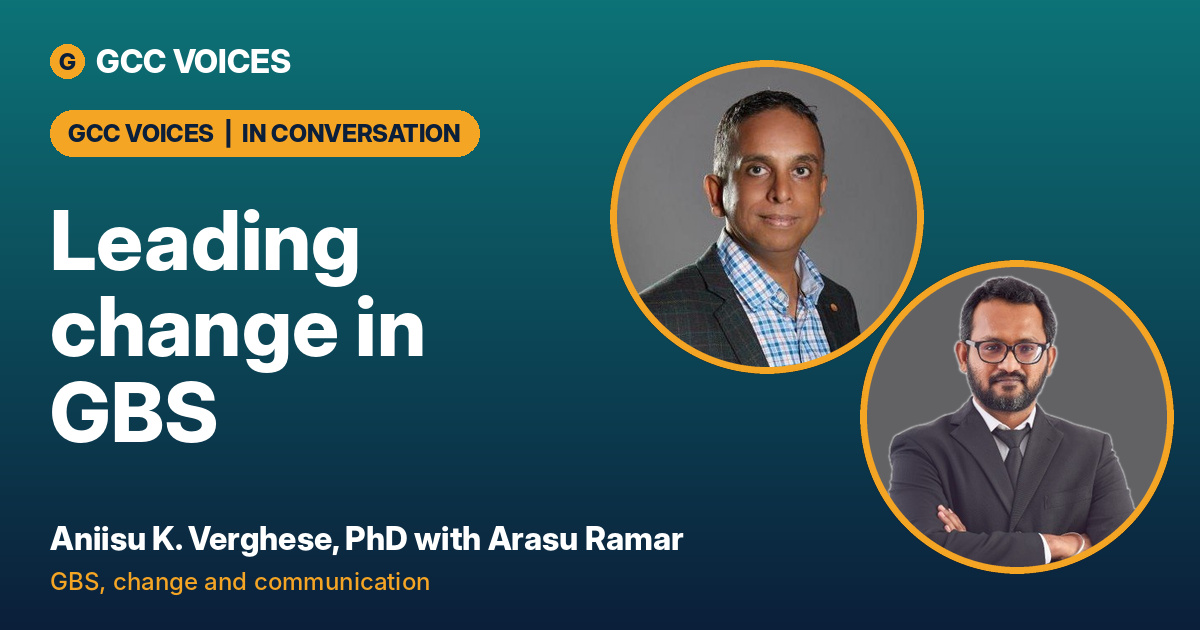
Ask a room of finance and shared services leaders how they communicate change, and most will describe the same routine: a project update, a go-live date, an email, a town hall. Then ask what people actually took away from it. For leaders in Global Capability Centres and Global Business Services organisations, where work, teams and technology keep moving, that gap between what was announced and what was understood decides whether a change lands.
In this edition of GCC Voices, I spoke with Arasu Ramar, APAC Global Business Services Site Lead at Zimmer Biomet, based in Petaling Jaya, Malaysia, where he also leads the regional Purchase-to-Pay process. Arasu began his career as a clerk in a receiving department and, across more than two decades, moved through accounting and finance into shared services start-ups, process migrations and regional leadership, with roles at Carrefour, Tesco, Ausenco, ZALORA and BASF along the way.
Our conversation was about change and communication, and what ties his answers together is a simple idea: change becomes real in everyday conversations between leaders and their teams.
Watch the interview on YouTube: https://youtu.be/1vgtWlbCYWs
From receiving clerk to site lead
Arasu began with a straightforward description of his path. He started as a clerk in the receiving department and gradually moved into accounting and finance. Over 22 years he has gone from managing day-to-day transactions to building and leading teams, managing process transitions, implementing new technologies and driving regional transformation.
He calls it a journey of continuous learning and adapting to change, and that framing sets the tone for everything that follows. He talks about change as something he has lived through at every level, not something he has only managed from above.
People expect a conversation, not just an announcement
Asked about the biggest shift he has seen in how change is led and communicated in finance and shared services, Arasu did not point to a new tool or channel. He pointed to expectation.
Earlier, communication focused on the new process and the implementation date. Today, people also want to understand why the change matters, how it affects them and whether they have a voice in shaping it.
“People expect a conversation, not just an announcement.”
Both sides of a transition need clarity early
Arasu has been part of shared services start-ups and process migrations, so I asked what people on each side need to hear when work moves to a new location or team. His answer covered three groups. The transferring team needs an honest conversation about their future and recognition for their knowledge. The receiving team needs clear expectations, training and support. Business stakeholders need confidence in service continuity.
His point on timing was just as clear. Communication has to continue through the transition, especially when leaders do not yet have every answer.
Standardise without steamrolling
Standardising a process across several APAC countries means working across cultures, languages and ways of working. Arasu starts by understanding why each market works the way it does. Some differences reflect local requirements. Others are simply habits.
Involving country teams is how he tells the two apart, and it changes how the standard is received. People are more willing to support a regional standard when they can see that their concerns influenced the design.
Leading through influence means earning commitment
As APAC Regional Process Owner for Purchase-to-Pay, Arasu influences people he does not manage directly. His approach is to explain the business problem, listen to competing priorities and show how the proposed change helps.
“Data opens the discussion, but relationships and follow-through build trust.”
People also need to know that he understands the impact on their team, which is why listening comes before persuading.
The hardest change: smaller conversations, earlier
One of the most demanding changes Arasu has led was bringing outsourced activities into the Malaysia team while keeping service continuity. Knowledge transfer had to be managed alongside people’s concerns.
Looking back, he would create more space for smaller conversations earlier. A project update shows progress against a plan. It does not always show what an individual is worried about.
Show the value of GBS in the language of outcomes
GBS is often seen as a cost or transaction centre, so I asked how he communicates the value of his team to business leaders and global stakeholders. Arasu connects the work to outcomes those leaders care about. In Purchase-to-Pay, that means paying suppliers reliably, strengthening controls and giving the business better visibility.
Productivity measures matter, he said, but leaders also need to hear what those measures make possible. The team’s contribution becomes clearer when stakeholders see the business problem it helped solve.
One core message, tailored detail
Keeping global leadership, business partners and a local team aligned across time zones takes discipline. Arasu keeps the core message consistent and tailors the detail to the audience. Global leaders need the business impact, partners need clear commitments, and employees need to understand their responsibilities.
Concise written updates help across time zones, and every decision needs a clear owner so that different conversations do not produce different directions.
IQ + EQ + SQ + PQ − EGO
Arasu’s leadership belief is an equation, and I asked him to unpack it. IQ is understanding the problem. EQ is understanding people. SQ keeps leaders grounded in values and purpose, and PQ gives them the energy to sustain the journey. Subtracting ego means staying open to feedback.
Which element matters most when a team is going through change? He would put particular emphasis on EQ, because people experience the same change differently.
Talk less, listen more
Arasu often says “talk less, listen more”, so I asked what that looks like in practice. It means asking people what will make the change difficult, then giving them room to answer. He also asks them to walk him through the actual work.
That second step is where the value shows up. Walking through the work reveals dependencies and workarounds that a process document misses.
“Listening helps us improve the solution before asking people to adopt it.”
Honesty when the answers are not ready
When teams face restructuring, automation or role changes, motivation is hard to hold. Arasu’s view is that people do not need leaders to pretend everything is certain. They need honesty, regular updates and practical support.
In practice, that means explaining what is known, acknowledging what remains undecided and discussing the next steps. Giving people opportunities to learn and contribute helps them regain some confidence and control.
AI and automation: be specific
On how GBS leaders should talk about automation and AI in Purchase-to-Pay and other finance processes, Arasu asked for specificity. Leaders should be clear about which tasks may change and what skills people will need.
In Purchase-to-Pay, AI could assist with queries and reconciliation, while people still need to investigate exceptions and take accountability. He would not promise that every role will stay the same. He would explain how the organisation intends to support the transition.
Who owns change communication?
In a GBS or GCC, should change and internal communication belong to the site lead, HR, a communications function or everyone? Arasu’s answer gave each a role. The site lead must be accountable, with HR and communications providing expertise and support. Managers make the message meaningful for their teams, and employees need channels to respond.
His test for good communication is practical: someone can explain why the change is happening, what it means for their work and where to get help.
Start checking understanding
I asked for one thing GCC and GBS leaders in the region should start or stop doing when communicating change. Arasu’s answer was to start checking understanding instead of counting announcements.
After communicating a change, ask a few employees to explain what it means for their work. Their answers will tell you much more than an email open rate.
“Sending a message is only the beginning.”
Advice for finance professionals who want to lead GBS
For finance professionals who aspire to move from process roles into GBS leadership, Arasu’s advice is to understand the process beyond your own desk. Learn how your work affects other teams and the wider business. Volunteer for transitions and improvement projects, and build the ability to explain problems clearly.
Technical knowledge gives you credibility. Helping people work through challenges is what prepares you for leadership.
Six lessons for GCC and GBS leaders
- People expect a conversation. Explain why the change matters, how it affects them and where they can shape it.
- Start early on both sides of a transition: honest conversations for the team moving work out, clear expectations and training for the team receiving it.
- Separate local requirements from local habits by involving country teams in the design of a regional standard.
- When you lead through influence, data opens the discussion and relationships and follow-through build trust.
- Be honest about what is known and undecided, and be specific about how AI and automation will change tasks and skills.
- Check understanding instead of counting announcements: ask employees to explain what the change means for their work.
Final thoughts
Arasu closed with a message that sums up the interview. Change becomes real in everyday conversations between leaders and their teams. As GBS leaders, we need to make time for those conversations, especially when the answers are difficult. People are more willing to move forward when they feel heard, understand the direction and trust that support will follow.
Over to you: When you last announced a change in your GBS or GCC, how did you find out what people understood, and what would you ask differently next time?
More GCC Voices conversations
- Trust Builds Capability: Paula Ordoñez Angel on Growing a GCC Beyond the Original Blueprint
- From Cost Centre to Growth Engine: Lai Gaik Chew on Leading Change Across APAC GCCs
- GCC Video Series | Spotlight on Change and Communications: A conversation with Rishi Tanna
- From Email Senders to Strategic Partners: Mónica Mayorquín on Change Communication in GCCs
Are you a GCC or GBS leader, site director or transformation executive with a perspective to share? Follow the GCC Voices page on LinkedIn (https://www.linkedin.com/company/global-capability-center-voices/) and get in touch to take part in a future edition.
About Arasu Ramar
Arasu Ramar is APAC Global Business Services Site Lead at Zimmer Biomet (since January 2024) and APAC Regional Process Owner for Purchase-to-Pay (since March 2022), based in Petaling Jaya, Malaysia. A finance professional whose career began in a receiving department, he has worked at Carrefour, Tesco, Ausenco, ZALORA and BASF, with expertise in process migration, shared services start-ups, standardisation, ERP, team building and stakeholder management. His leadership belief is IQ + EQ + SQ + PQ − EGO.