Ask a room of internal communicators how their function is seen, and many will smile and say the same thing: as the people who send the emails and organise the parties. For communicators working inside Global Capability Centres and Global Business Services organisations, that perception is more than an irritation. It decides whether they are invited into change projects at the start or called in at the last minute to rescue them.
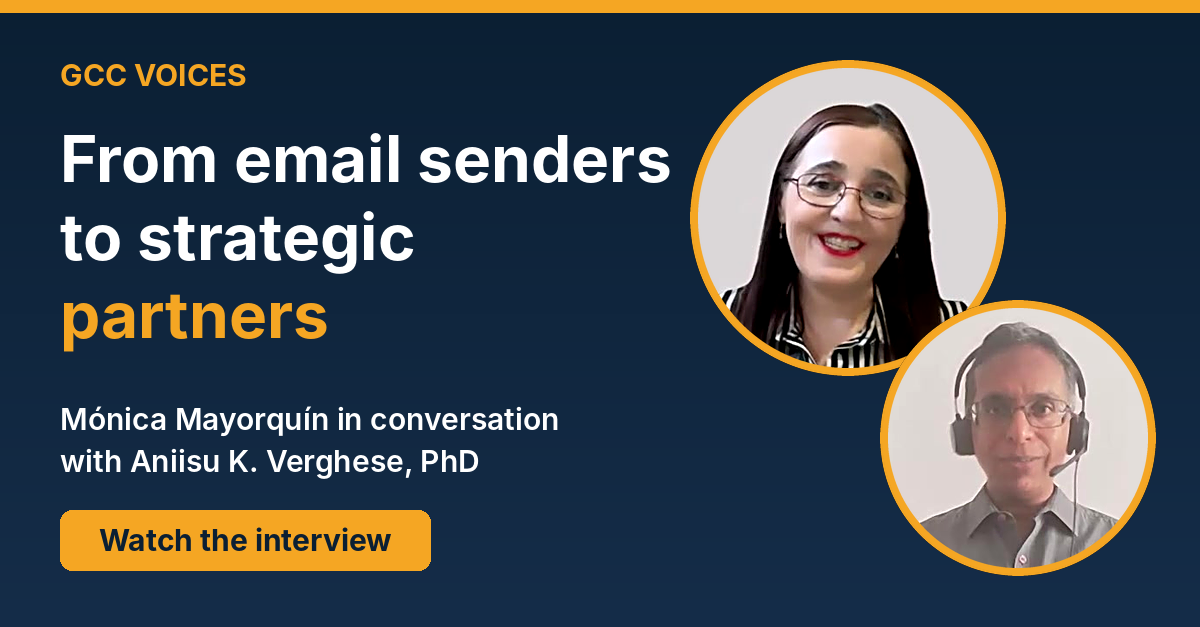
In this edition of GCC Voices, I spoke with Mónica Mayorquín, a change communication consultant from Guadalajara, Mexico. For twenty years she has led internal communication and helped communicate changes, restructurings and transformations at global companies including Nokia, GE, HSBC and Aptiv. At GE she even helped build the communications function for the shared services organisation in Latin America.
Our conversation ranged across employer brand, managers, measurement, headquarters and AI. What tied it together was a simple idea: communication earns influence when it is tied to behaviour and strategy, not to output.
Watch the interview on YouTube: https://youtu.be/2_AUQrT-Nmw
There is no single plan for every company
Mónica’s first lesson from two decades across the Americas and EMEA is that no communication plan fits every company, and often not even every location within one. You cannot communicate change in a country office the way you do at headquarters. You have to be mindful of who your audience is, speak in the language they understand and use the channels they trust.
That also means working with headquarters. Not everyone there has the same level of understanding of local realities, and the differences run from country to country and even from city to city within a country. Part of the communicator’s job is to help headquarters see this.
Maturity means influence, not output
Asked what a mature communication function looks like inside a GCC or GBS organisation, Mónica did not talk about channels or content. For her, maturity is having influence with leadership teams and internal stakeholders, and positioning internal communication as a strategic function.
She acknowledged the stereotype directly: communicators are sometimes seen as the email senders or the party organisers. Her answer is to keep demonstrating otherwise.
“We are strategic functions that help move the needle in an organization.”
A global brand opens the door, local ways of working keep people
On employer brand, Mónica was pragmatic. The parent company brings candidates to the interview, and a GCC should use that weight to its advantage. But candidates and employees should also hear that the centre shares the global strategy and priorities while having local priorities and ways of working that fit the culture where it sits.
Her distinction is a useful one. The values and behaviours expected of employees stay constant. What can adapt locally is the way of working.
Leaders own the employee experience
When I asked about the gap between what an employer value proposition promises and what employees experience, Mónica put the weight on leaders. If leaders say they will do something, they need to do it, because employees are always watching. Whatever is said at a town hall, in an email or in a meeting, people will hold leaders accountable for.
She also drew a clear line of ownership.
“I think HR owns the employee promise, but eventually leaders own the employee experience.”
A bad experience with a leader, she added, eventually makes the employee leave. In her recently published book on internal communication she uses the comparison between human biology and corporate biology, describing the organisation as a living organism that needs care.
The talent story has to be lived, not just told
As GCC mandates move from execution towards innovation and enterprise impact, Mónica believes the talent story should engage existing employees first, because they are the biggest ambassadors. It should also show candidates what they can do and the opportunities ahead of them in building the future of the centre.
But the story only works if the experience backs it up. It is not about salary any more, she said, and it is not about pizzas on Friday. People need to feel seen, heard, valuable and respected, and rewarded. That includes recognising extraordinary work wherever it comes from, not only rewarding the people you are friendly with.
Why technology gets the budget and people do not
Responding to research showing gaps in AI training, change management and culture inside GCCs, Mónica explained why the human side is so often under-invested. Technology spend is easy to measure: it has a budget, a timeline and an owner. People are harder to measure, so organisations tend to forget them.
She would reverse the priority. People are the ones who do the actual work, and machines do not move or develop by themselves. Training and development should get at least as much investment as technology, or even a 50/50 split.
“I think we need to humanize companies.”
Equip managers to translate, not just forward
Managers sit between the global message and the employee’s reality. Mónica’s approach begins with finding out where managers actually are on communication skills. Not every manager knows they are responsible for communicating to their team, and some do not know how, perhaps because it is their first people-manager role or because the company has never trained them. When that is the case, tell HR.
Then equip them. Internal communicators should prepare a toolkit that explains what the change is, what is changing, why now, and how it affects the team and each role. Add a Q&A with the most frequently asked questions, and tell managers what to say when they do not know the answer, because early in a change nobody has every answer. Finally, tell them who to contact.
Measure what changed, not what was sent
Mónica has changed how she measures communication. She now looks at what happens after the message is sent.
“What we are eventually looking at is what changed after the employee received a message.”
Did we ask people to take an action? Did they do it? Did they change their behaviour? Evidence of behaviour change is what tells her a change has landed.
She shared an example from a strategy-sharing campaign. Leaders were invited to a strategy event and asked to cascade the strategy to the next level, and so on down to the last level. Later, employees were asked in interviews and meetings whether they understood the strategy and what it meant for them. The proof came when they entered their goals into the system and it was clear how their work would contribute to the company’s success.
What headquarters misses, and what to standardise
Headquarters most often misses that people do not share the same language, customs or channels, and that local leaders have their own communication style. Mónica has held local, regional and global roles, and she credits that for being able to explain local needs to global colleagues. Her advice is to go to the local offices and see how people work, how they live and how they prefer to be communicated with.
On where autonomy should stop, she gave a clean list.
- Keep global: strategy priorities, the vision and mission, and the values and behaviours expected of all employees.
- Adapt locally: language, the channels employees prefer, local spokespeople, and the examples and success stories that make a message relevant to a community.
AI and your next 90 days: stop saying yes to everything
On AI, Mónica’s advice was to stop doing repetitive work. Activities such as sending emails and managing distribution lists, a big topic in every company she has worked in, can be automated. That frees communicators to be the strategic partner they are, even where the company does not yet see them that way. They should also ask the questions nobody asks when a change project starts. Communicators are often invited last, and when they start asking questions they find gaps that are obvious to them but had not been considered.
Her 90-day advice for communicators treated as a support function has two steps. First, stop saying yes to every request. Second, build a communications brief and ask the right questions:
- What are we trying to achieve with this project?
- Why is it important, and is it linked to the company strategy?
- How will we measure success after the change has been implemented?
- What do you want people to do differently?
She described the requests she used to receive: please send this communication, it is important. But when she read it, there were no clear messages, no action points for employees and no deadline. That, to her, is not strategic. Not everything is important for everyone.
The belief to retire: communicators as rescuers
I closed by asking what belief the industry needs to stop holding. Mónica’s answer was that communicators are the rescuers of change projects. Invited at the last minute, they find gaps that should have been fixed or considered by the project manager. Communicators can make a change plan clearer and easier to understand, but they cannot own a project or design its timeline.
“That’s a project manager’s role, not communications.”
Five lessons for GCC leaders and communicators
- Adapt the message, the language and the channel to the audience, and help headquarters see why.
- Keep strategy, mission, values and behaviours global. Localise language, channels, spokespeople and stories.
- HR owns the employee promise. Leaders own the employee experience.
- Measure behaviour change after the message, not reach or open rates.
- Involve communicators at the start of change projects, and let them say no to requests with no clear purpose.
Final thoughts
Mónica’s conversation is a practical reminder that influence is built, not granted. It comes from asking better questions, tying communication to behaviour and strategy, and equipping managers and leaders to do their part. For GCC leaders, the invitation is to bring communicators in at the start. For communicators, it is to earn that seat by being clear about what success looks like.
Over to you: At what point are communication and change professionals brought into projects in your GCC, and what would change if it were earlier?
More GCC Voices conversations
- Trust Builds Capability: Paula Ordoñez Angel on Growing a GCC Beyond the Original Blueprint
- From Cost Centre to Growth Engine: Lai Gaik Chew on Leading Change Across APAC GCCs
- GCC Video Series | Spotlight on Change and Communications: A conversation with Rishi Tanna
Are you a GCC or GBS leader, site director or transformation executive with a perspective to share? Follow the GCC Voices page on LinkedIn and get in touch to take part in a future edition.
About Mónica Mayorquín
Mónica Mayorquín is a change communication consultant from Guadalajara, Mexico, with twenty years of experience leading internal communication and communicating changes, restructurings and transformations at global companies including Nokia, GE, HSBC and Aptiv. At GE she helped build the communications function for the shared services organisation in Latin America. Connect with her on LinkedIn.
About GCC Voices
GCC Voices is an interview series hosted by Aniisu K. Verghese, PhD, a change and communication leader, author and speaker, featuring conversations with Global Capability Centre leaders, site directors and transformation executives on leadership, communication, change and the future of enterprise capability.