Global Capability Centres are being asked to do far more than run processes reliably and cheaply. As AI, automation and hybrid work reshape what enterprises expect from them, the real test is whether a centre can build new capability while bringing its people, and its stakeholders across many cultures, along with the change.
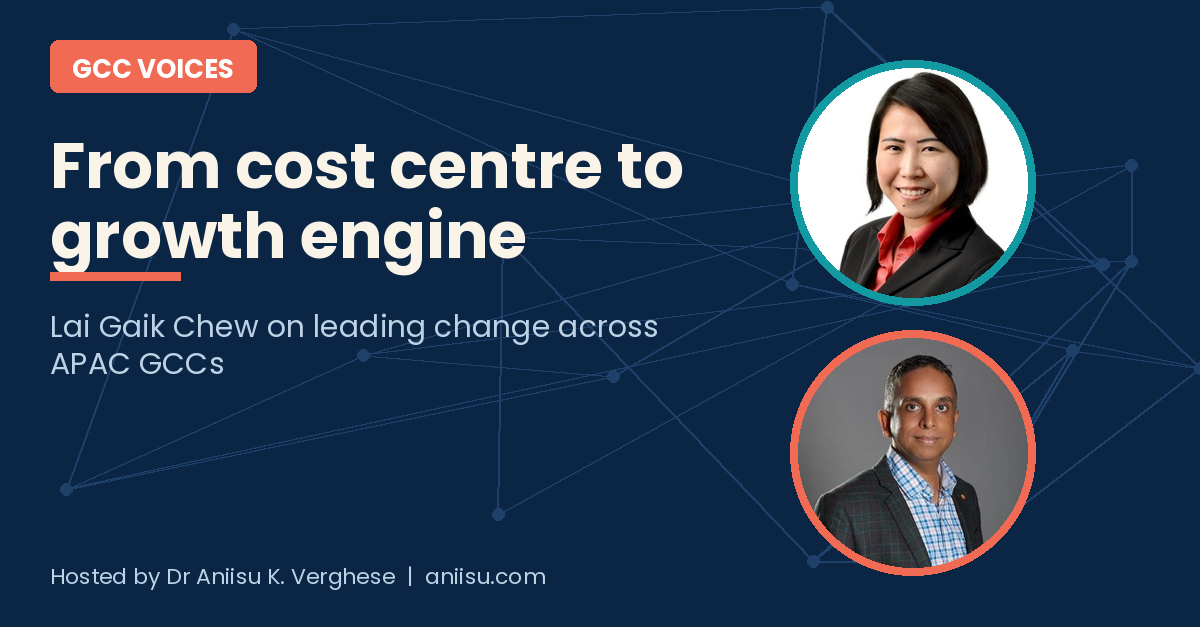
In this edition of GCC Voices, I spoke with Lai Gaik Chew, a GBS and finance transformation leader with more than twenty years of experience across Asia Pacific. Lai Gaik was part of the pioneer leadership team that set up Kimberly-Clark’s APAC shared services centre in 2007, grew it into a standalone entity serving 14 countries and more than 220 people, and most recently led the GBS organisation and operating model for Zalora Group.
What stood out in our conversation was how consistently she linked operating model choices to communication. Her view is simple: a GCC cannot become a strategic growth function if the people who explain and shape change are brought in only to announce it.
Watch the interview on YouTube: [INSERT YOUTUBE URL]
Two very different GBS journeys
Lai Gaik’s first GBS journey began in 2007, when a team of just over 20 people in Malaysia started supporting four markets: Malaysia, Singapore, India and Indonesia. By 2012 it had become a standalone legal entity, and over time it consolidated services for all 14 APAC countries. The scope covered record-to-report, procure-to-pay, order-to-cash, master data, treasury, tax, statutory accounting, tactical sourcing, contract management and procurement operations. At its peak the operation exceeded 220 people.
Her second journey was a different kind of transformation. At Zalora Group she led the build of a modern, digital-first GBS of around 80 professionals across the region, covering finance, marketplace finance, risk, insurance, internal control and master data. The mandate, she explained, was not just efficiency. It was agility, innovation and enabling business growth.
From back office to strategy engine
Asked how the purpose of GCCs has shifted, Lai Gaik did not hedge. The ambition has fundamentally changed. GCCs and GBS organisations are no longer cost-efficient back offices; they are becoming strategy engines.
She pointed to four forces behind the shift:
- Moving up the value chain, from transactional delivery to complex strategic work linked to revenue and innovation.
- The AI and automation mandate, which she described as non-negotiable.
- Access to global tech talent, including digital and engineering skills that headquarters often struggles to hire.
- Ownership of data infrastructure, with GCCs increasingly becoming custodians of enterprise data and the foundation for AI ambitions.
Her summary was that the GCC is no longer a support function. It is a growth function.
Where change loses momentum
From my own work in change and communication, I wanted to know where change initiatives most often lose credibility inside a GCC. Lai Gaik named three places.
- Lack of clarity. People do not understand what is changing, why it matters, or how it affects their daily work.
- Lack of support. Super users are not empowered to guide teams through the transition.
- Weak post-implementation follow-through. Many projects stop short of proper hypercare. We celebrate the go-live, she said, but what matters is the support that follows for the people on the ground.
Communication, in her words, is the glue that holds these together. It builds understanding, reduces uncertainty and helps teams navigate cultural differences. In a GCC, she added, communication is not only about updates. It is about creating psychological safety during change.
One global process, locally compliant and operationally effective
GCC leaders often sit between global process owners who want change to happen quickly and local teams who work within specific regulations and realities. Lai Gaik describes good change leadership as balancing principles with pragmatism: protect global standards where they drive control, consistency and efficiency, and adapt where local regulation requires flexibility. The art, she said, is knowing when to hold the line and when to localise, supported by structured governance and transparent communication.
“One global process, locally compliant and operationally effective.”
Culture sharpens the challenge. Asia Pacific is not homogeneous. Languages, hierarchy and comfort with uncertainty differ widely between markets. Lai Gaik argued that change must be communicated in local languages, not just English, and that messages should highlight market-specific impacts rather than generic global narratives. Global leaders often underestimate how differently teams process authority, feedback and ambiguity. They want fast, consistent messaging, and the GCC has to translate it into communication that resonates locally.
From cost arbitrage to value arbitrage
On the industry shifts reshaping GCCs, Lai Gaik chose two: AI adoption and hybrid work. Both, in her view, are changing the identity of the centre.
The first is a move from cost arbitrage to value arbitrage. GCCs can no longer justify themselves on headcount or cheap labour. They need to position themselves as owners of AI implementation, data analytics and enterprise problem solving. The second is a move from people management to hybrid workforce orchestration, where leaders manage a blended ecosystem of people, machines and digital workflows.
She also highlighted what other centres can learn from India’s GCCs, which she sees leading in data and AI engineering. Two practices stand out for her. One is the hub-and-spoke data model, where centralising data governance and engineering creates consistency, scalability and better analytics outcomes. The other is a product management mindset, treating analytics teams as product teams accountable for outcomes, adoption and continuous improvement rather than as service providers. That shift, she suggested, turns delivery centres into innovation centres.
Bring communicators in before the announcement
This was the part of the conversation closest to my heart. When I asked what GCC leaders can do to help change and communication professionals do their best work, Lai Gaik offered three things.
- Co-create the content. Leaders who understand market dynamics and stakeholder concerns should help shape the narrative, not simply approve it.
- Enable open dialogue. Change works when employees can share real feedback without fear, so leaders must create safe spaces for people to speak up.
- Involve communication teams early. They should be part of the strategy from the beginning of the project, not just at the announcement.
She applies this in practice by bringing communication professionals into the project team from day one. When they understand the “why” behind a transformation, they can craft messaging that resonates rather than producing surface-level campaigns. She also commits to transparency. During large-scale transformations, leaders who openly acknowledge challenges give communication teams something real to build trust on, rather than just speed.
The ideal relationship, as she sees it, is a partnership in which leaders own the strategic vision and communication teams facilitate two-way dialogue, with a shared purpose that aligns enterprise priorities with ground-level realities. It breaks down when communication becomes too top-down: aligned with senior leadership but disconnected from employee experience. It breaks down further when the team is reduced to what she called an “announcement machine” with no access to feedback loops about how the content, or the project itself, is landing.
Advice for communication and change professionals
For professionals who want to be taken seriously as business partners in a GCC, Lai Gaik drew on conversations with communication colleagues who supported her projects. Her advice:
- Shift from outputs to outcomes. Get involved early enough to help answer which business problem is being solved and how adoption will be measured.
- Focus on business metrics, not activity. Tie communication work to adoption rates, retention of critical talent or risk reduction.
- Spot friction early. Use your cross-functional vantage point to bring solutions, not just observations.
- Speak the language of the business. Understand the financials, service level agreements, NPS and cost drivers, and translate technical content into hard data.
- Keep upskilling. Digital literacy, data analytics, cross-cultural influence and agile methods all matter, because GCCs are evolving fast and communicators must evolve with them.
The next phase of GCC maturity
Looking ahead, Lai Gaik expects communication, employer branding and change capability to be central to how GCCs evolve. As automation absorbs transactional work, change capability will determine how quickly hundreds of employees can be reskilled into higher-value roles. Employer branding will help a centre stand out in attracting digital talent. Communication will help shape a culture of experimentation, where teams can pivot quickly and learn fast.
Her closing thought was that the next phase of GCC maturity is not just operational. It is cultural, and communication is the bridge.
Five leadership lessons
- A GCC earns strategic standing through value, not headcount: AI, data and problem solving.
- Change loses momentum through unclear purpose, thin support and weak hypercare.
- One global process works only when it is locally compliant and communicated in local terms.
- Communicators need a seat at the start of a project, not a slot at the announcement.
- Transparency and safe feedback channels build trust faster than polished messaging.
Final thoughts
Lai Gaik’s experience across two very different GBS organisations points to a theme I hear again and again in GCC Voices. The technology and the operating model matter, but they succeed through people who understand why change is happening and feel safe to say how it is landing.
For GCC leaders, that means treating communication and change professionals as partners in shaping decisions. For practitioners, it means learning the business well enough to earn that seat.
Over to you: How early are communication and change professionals involved in your GCC’s transformation projects, and what helps your global messages land locally?
About Lai Gaik Chew
Lai Gaik Chew is a Global Business Services leader and transformational thinker, formerly with Zalora Group and Kimberly-Clark, with more than twenty years of experience across Asia Pacific. She was part of the pioneer leadership team that set up Kimberly-Clark’s APAC shared services centre in 2007 and later led the GBS organisation and operating model for Zalora Group. Her work spans SAP S/4HANA implementations, global process standardisation, AI-enabled automation and internal controls.
About GCC Voices
GCC Voices is an interview series hosted by Aniisu K. Verghese, PhD, a change and communication leader, author and speaker, featuring conversations with Global Capability Centre leaders, site directors and transformation executives on leadership, communication, change and the future of enterprise capability.