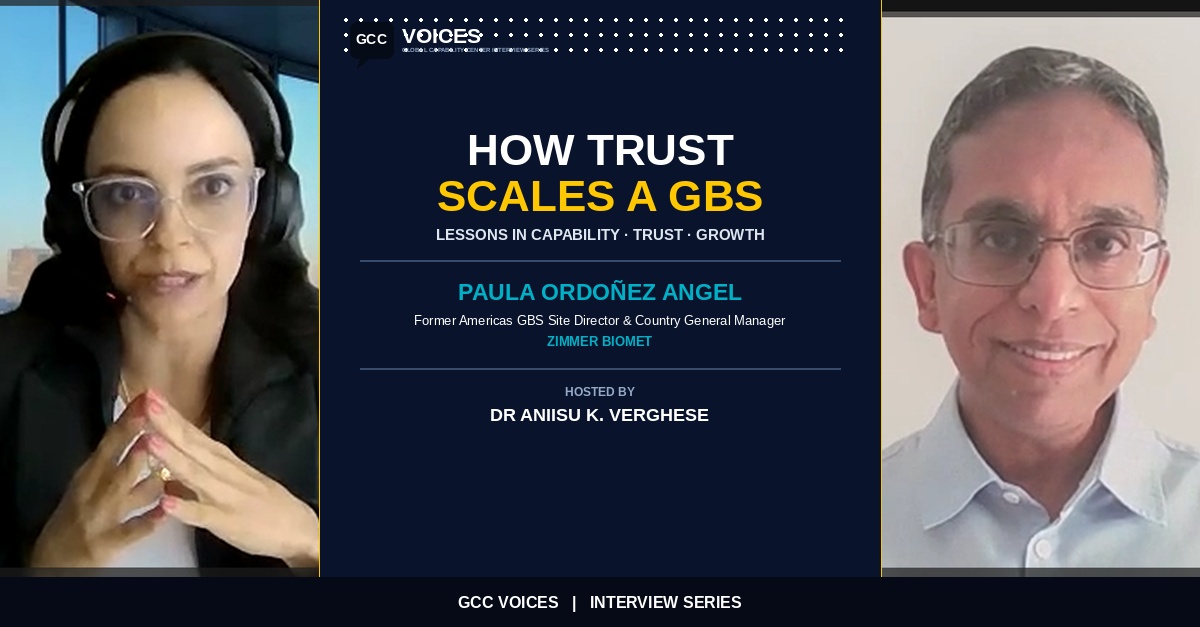
In this next episode of #GCC Voices, I sat down again with Paula Ordonez Angel, former Americas #GBS Site Director and Country General Manager at Zimmer Biomet, to talk about what actually builds trust when you’re scaling shared services across multiple countries.
Paula shared a story from her own career where every box was checked except one: executive sponsorship. And that one gap was enough to turn every minor hiccup into proof that the move shouldn’t have happened.
We also covered:
– Why #Colombia has moved from a cost play to a strategic capability location
– How site leaders should decide when to push back on global HQ versus adapt locally
– What the first six months should look like when you inherit a transactional service center
– Why psychological safety shows up in daily conversations, not in the number of programs you run
Full conversation is live on YouTube. https://lnkd.in/g669BD9y
Read summary below:
1. Navigating Change and Leadership Alignment
Aniisu: What is a change initiative you were part of that didn’t work out as planned, and what did you learn from the gap between global strategy and local execution?
Paula: When setting up complex capabilities, things don’t always go as expected, and we have to be prepared for that.
I recall an experience where everything on paper was aligned. We had the technical perspectives right, the talent was ready, transition plans were structured, and governance was in place. However, we underestimated the importance of executive leadership sponsorship. The global functional leader for that process wasn’t fully bought into the transition and wasn’t supportive of the plan.
That lack of alignment created significant friction. Every minor issue during transition was interpreted as proof that the move shouldn’t have happened or that the local team was unprepared. It created mistrust, uncertainty, and disempowered the team.
The biggest takeaway is that if leaders are not fully aligned with and genuinely convinced of the change, it becomes nearly impossible for the broader organization to build confidence and reach its full potential.
2. Balancing Global Strategy with Local Nuances
Aniisu: How do you personally decide when to push back on global headquarters versus when to adapt the global model locally?
Paula: I don’t view it as a choice between pushing back or simply making the model work locally. The site leader’s role is to help both global headquarters and local teams make the best decisions for the business as a whole.
Global teams establish strategic direction, priorities, goals, and standardization. As local leaders, our role is to ensure that strategy can be executed effectively within the reality of the local market. There will be times when local regulations, compliance requirements, or operational constraints mean a standardized global solution isn’t the right fit. In those moments, local leaders must speak up using data and clear business logic to propose viable alternatives.
Conversely, if resistance from a local team stems simply from discomfort with change, the site leader’s job is to help them understand and embrace the global direction. There is no single formula, but decision-making must always be guided by shared trust, transparency, and business value rather than organizational politics.
3. Colombia’s Evolution as a Strategic Capability Hub
Aniisu: Colombia is increasingly recognized as one of the fastest-growing GBS hubs in Latin America. Beyond cost efficiency, what is driving this growth?
Paula: Years ago, global organizations looked to Latin America primarily for cost savings. Today, the conversation has fundamentally shifted. While cost remains a factor, the primary question from global leaders now centers on capability and talent.
Colombia’s GBS ecosystem has matured significantly. Key drivers include:
- Talent and Education: A highly educated, multilingual workforce backed by strong university networks.
- Cultural Resilience and Adaptability: A workforce with strong critical thinking skills, a customer-oriented mindset, and a commitment to continuous improvement.
- Strategic Alignment: Excellent time zone compatibility across the Americas and a mature infrastructure supporting global delivery.
Colombia is no longer seen merely as an operational cost play, but as a strategic location capable of delivering long-term business value.
4. Measuring Psychological Safety and Learning Culture
Aniisu: You advocate for psychological safety and continuous learning in leadership. How do you measure whether that is genuinely taking root in a team?
Paula: Wellbeing programs and structured learning initiatives are important, but psychological safety cannot be measured solely by the number of programs you run. It must be evaluated through everyday behaviors.
Key behavioral signals to look for include:
- Do team members feel comfortable speaking up and challenging ideas respectfully?
- Are employees comfortable asking for help or admitting mistakes openly without fear of reprisal?
- Is there an open, constructive dialogue around operational challenges and continuous improvement?
While traditional HR metrics such as engagement surveys, retention rates, and training participation provide useful baseline data, the true test of psychological safety lies in the quality of daily conversations and the level of trust within the team.
5. Transforming Transactional Operations into Capability Hubs
Aniisu: For a leader inheriting a transactional service center, what should the first six months look like if the goal is to transition it into a strategic capability hub?
Paula: The first priority is to avoid the temptation to rush into expansion immediately. You must first establish a solid foundation to ensure sustainable growth.
A practical six-month roadmap includes:
- Establish a Clear Baseline: Evaluate current service maturity, performance metrics, and customer satisfaction levels to understand where the center stands.
- Engage Key Stakeholders: Identify process owners, decision-makers, and key influencers across the organization to build trust and align expectations early.
- Deliver Quick Wins: Focus on small, visible operational improvements to build credibility and demonstrate value early on.
- Embed Transformation Capabilities: Where appropriate, establish a dedicated Transformation Office or integrate change management and continuous improvement practices. This shifts the organizational mindset from routine execution to continuous value creation.
6. The Future of Americas GBS Leadership
Aniisu: Where do you see GBS leadership in the Americas evolving over the next three years?
Paula: The focus will remain on evolving operational centers into high-value capability hubs while developing local talent into global leaders.
Building high-performing, people-centric cultures allows local teams to take on broader international responsibilities. Watching professionals grow, advance their careers, and step onto global stages is one of the most rewarding aspects of leading in this space, and it will continue to drive the maturity of the region.
7. Strategic Leadership and Culture Building
Aniisu: What advice do you have for GBS site leaders regarding change management, employer branding, and communication?
Paula: A site leader’s role extends far beyond managing daily operations. Site leaders must actively shape culture and articulate the broader vision.
Leaders need to help employees understand where the organization is going, why the journey matters, and how their individual contributions connect to the overarching strategy. When communication and change management are integrated into leadership practice, teams move from basic operational compliance to authentic engagement.