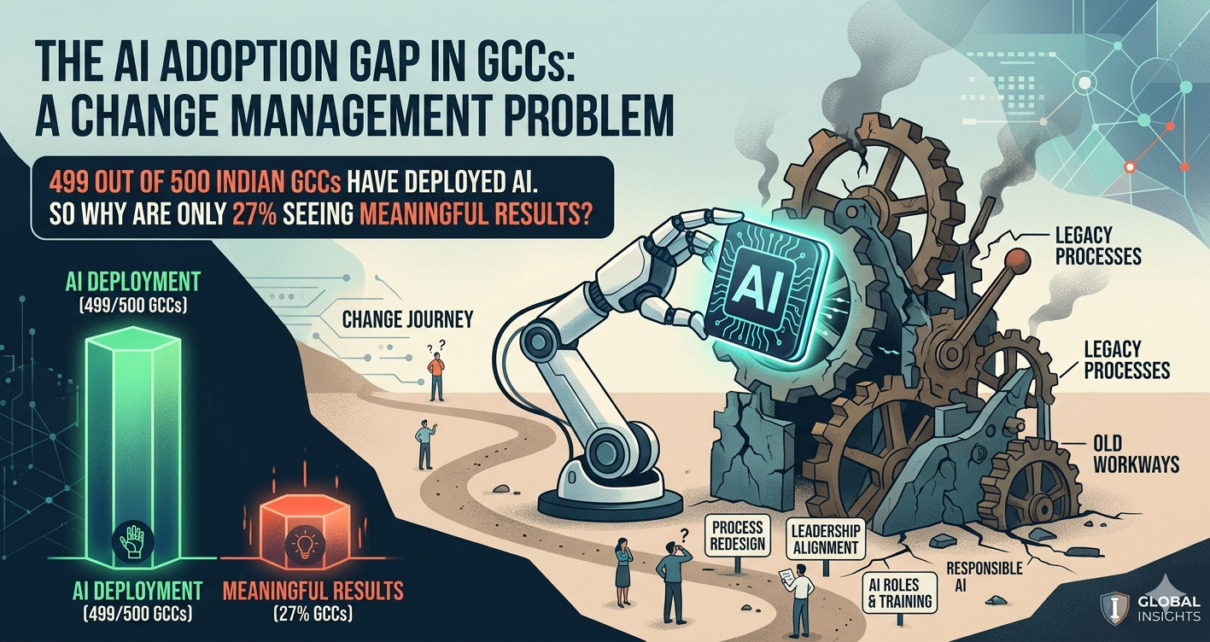
499 out of 500 Indian GCCs have deployed AI. So why are only 27% seeing meaningful results?
That number, from the Infosys AI-First GCC Index 2026, is striking. Nearly universal adoption, and yet two-thirds of GCCs cannot point to significant improvement from their AI investments. If that does not prompt a hard look at how change is being managed inside these centers, it should.
The research, based on a survey of 500 GCCs covering roughly 29% of India’s ecosystem, is one of the most comprehensive looks at AI maturity in the GCC space to date. And what it surfaces is not primarily a technology problem. It is an organizational one.
Adoption without transformation is not progress
On average, AI enhances only 31% of tasks within a GCC’s processes. That means roughly seven out of every ten tasks are still running the way they always have, with AI layered on top in some adjacent capacity. The research puts a number to what many practitioners already sense: deploying AI and transforming how work gets done are very different things.
The process redesign finding is the most compelling in the report. GCCs that completely redesign existing processes when implementing AI are 30% more likely to report significant improvement. Those that make only major changes still gain, but the uplift drops to 14%. Minor changes produce no statistically meaningful advantage. The implication is clear: patching existing processes with AI tools is not a change strategy. It is a workaround.
This is a conversation that change practitioners have been having for years in other contexts. ERP implementations, shared services transitions, offshoring programs. The organizations that struggled were nearly always the ones that automated broken or under-designed processes rather than rethinking them. GCCs are now running the same risk at scale, with AI.
The people dimension is where the gap widens
The report identifies defined AI roles and career pathways as one of the strongest predictors of improved outcomes. GCCs with clear role definitions and career progression for AI-related work are 19% more likely to see significant improvement. And yet only 17% of GCCs have achieved this level of clarity. A third have barely started.
Think about what that means for employees living through this transition. AI is being deployed across their function. Processes are changing around them. But in most centers, no one has told them clearly what an AI-augmented role looks like for them personally, or where it leads. That is not just an HR gap. It is a communication failure, and a significant one.
The report also finds that internal training programs, adopted by 73% of GCCs, show no statistical link to improved AI outcomes. Quality matters more than volume of training. This should prompt GCC leaders to ask a more honest question: are our training programs designed to shift how people work, or to tick a box that we have addressed the capability question?
By contrast, appointing internal AI champions improves outcome likelihood by 7%, and setting up dedicated AI innovation teams adds another 5%. These are structural decisions about how change is resourced and embedded, not just content decisions about what skills to build. A change agent network, which is effectively what AI champions represent, drives adoption in a way that a training course rarely does on its own.
Leadership alignment is not optional
The governance findings in the report deserve more attention than they typically get in AI coverage. GCCs that report to CEOs, CIOs, or business unit heads are 5 to 10% more likely to achieve significant AI improvement than those that report to COOs. Leadership-driven AI initiatives outperform those driven by GCC leaders alone, and middle-management-led initiatives actually correlate with worse outcomes.
This maps directly to what change management research has shown consistently: active and visible sponsorship from the right level of leadership is one of the most reliable predictors of change success. The reporting line matters because it signals strategic priority. A GCC that reports to a COO is, by structural design, closer to operations management than to strategic transformation. The proximity to decisions about business direction shapes what AI gets used for and how ambitiously it is deployed.
The communication implication is equally important. When AI initiatives originate at senior HQ level, the mandate is clearer, the resources tend to follow, and the story that gets told to employees is more coherent. When initiatives bubble up from the middle, the narrative fragments. People in different teams hear different things about why AI is being rolled out, what it means for their work, and where the organization is headed. That confusion has a cost.
Responsible AI governance needs a communication strategy of its own
The report identifies what it calls the RAI paradox. Almost 80% of GCCs have defined responsible AI policies, but fewer than a third consistently enforce them. Those that do enforce consistently see a 9% uplift in outcomes. The small number of GCCs with no RAI policy at all currently show better short-term outcomes, but the report rightly frames this as a risk rather than a model to follow.
What is less explored in the research, but significant in practice, is the communication dimension of responsible AI governance. Most GCCs have written a policy. Far fewer have thought carefully about how to make that policy meaningful to the people who work under it. Governance frameworks that live in a SharePoint folder rather than in team conversations and leadership behavior will not change how AI is used day to day. Enforcement requires communication: of expectations, of consequences, of the values that underpin the policy. Without that, a policy is simply a document.
Talent sourcing tells a story about change readiness
One finding that tends to get less coverage is the talent sourcing data. GCCs that source AI talent from academic institutions are 6% more likely to see significant improvement than those that rely on internal transfers from the parent company, which actually correlate with a 5% lower likelihood of improvement. This is counterintuitive on the surface. Internal transfers bring institutional knowledge. But they also bring existing habits, assumptions, and ways of working that can resist the behavioral change AI transformation requires.
Academic hires are not carrying the weight of how things used to work. They are, by default, more likely to engage with AI-native ways of working from day one. This is a lesson about change readiness, and it has implications for how GCCs think about building AI capability versus buying or borrowing it.
**What GCC leaders should be doing differently**
The research offers six recommendations, and they are sensible as far as they go. Redesign processes fundamentally. Define AI roles and career pathways. Partner strategically. Source talent from academia. Enforce responsible AI governance. Align with strategic leadership.
But from a change management and communication perspective, the recommendations need a layer underneath them. Process redesign requires stakeholder engagement, impact assessment, and structured transition support, not just a technology decision. Defining AI roles requires transparent conversations with current employees about what is changing and what is not, well before the roles are formalized. Governance enforcement is a communication and culture challenge as much as a policy one. And leadership alignment without a coherent, consistent narrative reaching the broader workforce is alignment that stays in the boardroom.
The 73% gap between GCCs that have deployed AI and those that can demonstrate significant improvement is not primarily a capability gap. It is a change management gap. The GCCs that close it will be the ones that treat the human and organizational dimensions of AI transformation with the same rigor they apply to the technology.
What would it take for your center to be in the 27%?