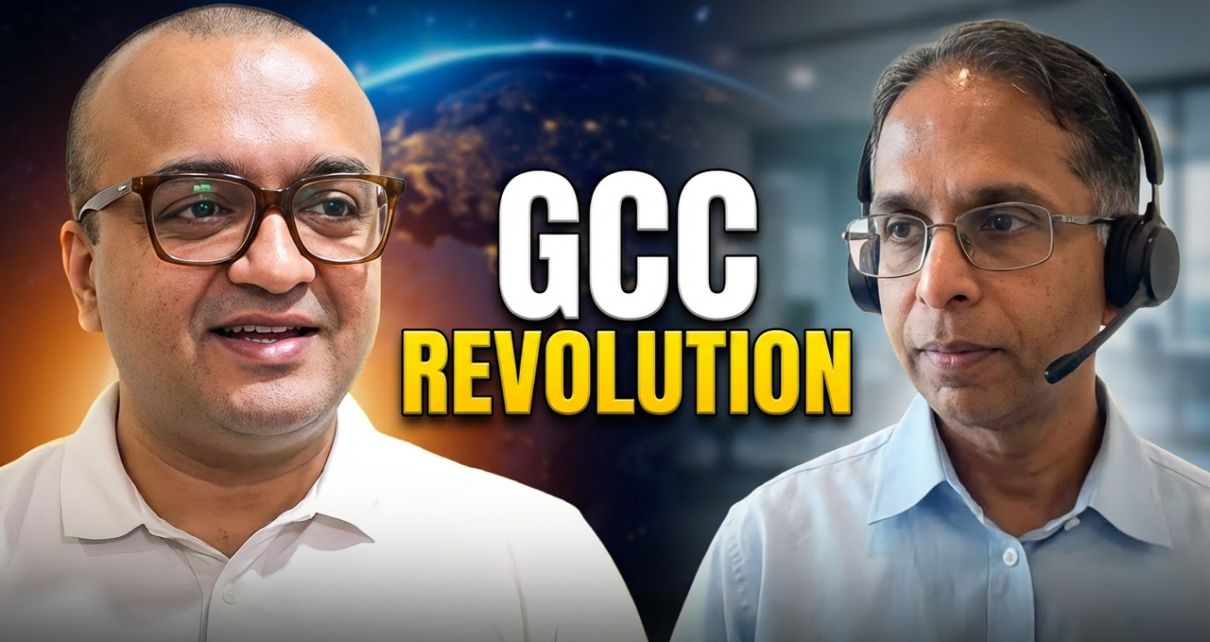
In the first edition of the Global Capability Center Video Series, I speak with Rishi Tanna, a marketing and communications leader with two decades of experience across financial services, including banking, wealth management, insurance, and GCC environments.
Our conversation explores a question many communicators in Global Capability Centers are grappling with today: how does the function move beyond execution to influence? We discuss employer branding, bridging headquarters expectations with local realities, the growing importance of change communication, leadership credibility during transformation, and the capabilities communicators now need in a world shaped by AI and constant organizational change.
Rishi shares a practical perspective drawn from experience. He challenges common assumptions about engagement, reframes the role of internal communication, and explains why understanding the business may be the single most important capability a communicator can develop. He also offers a framework for driving adoption during change and discusses how GCC communication teams can evolve into strategic partners rather than support functions.
Watch interview now!
Transcript (Q&A)
Introductions
Aniisu:
Hello Rishi, thank you for joining the GCC Video Series on marketing, communications, and change. I am really pleased to have you here. You have been a pioneer in reshaping how we think about communications, branding, and change, so I thought you would be the right person to share insights with our viewers.
To begin, could you introduce yourself and talk about your role within a GCC?
Rishi:
Thank you for the introduction. I would not say I am here to give advice. This is really two communications professionals having a conversation, and hopefully the audience can derive insights from it.
I have around 20 years of experience across communications, marketing, PR, and brand building, largely within financial services. That includes banking, wealth management, insurance, car leasing, retail brokerage, and financial services GCCs. I genuinely enjoy the sector and feel I have found my calling as a communications professional within the financial services GCC ecosystem.
The maturity of internal communication and local nuance
Aniisu:
With the GCC market expanding rapidly, I wanted to start with employee branding and change management. How would you describe the maturity of internal communication and change in your organization today?
Rishi:
For me, internal communication is not a department that simply transmits information. It translates information into local context.
In a matrix global organization, global messaging exists, but local nuance must be added. You cannot just be a transmission channel. You must be a translation channel. That is the real value of internal communication.
Headquarters vs local realities
Aniisu:
Many communicators operate tactically because they are directed by headquarters. You seem to approach it differently. How do you balance headquarters expectations with local realities?
Rishi:
It begins with knowing the business. When you know the business, you gain access to the room. When you speak the language of the business, you earn a seat at the table.
If you simply take global communication and publish it, you remain an executor. I tell my team: understand the business. Where does revenue come from? How does the organization operate? How are salaries paid? How does the machinery run?
Once you understand this, you are respected as a strategic enabler rather than liked for execution. Respect comes from business understanding.
From cost center to growth enabler
Aniisu:
You have tried to move communications from a cost center to a growth enabler. How did you approach that?
Rishi:
When most communication teams start, they are assigned events. Annual day, sports day, bring your kids to work. That becomes the perceived role.
But engagement is not the communication team’s responsibility. Engagement is the organization’s responsibility.
What communication should do:
- pre event communication planning
- on ground communication support
- post event storytelling
We should not own logistics. When you stop owning logistics, you gain bandwidth. That bandwidth allows you to build centers of excellence and align with global goals, not just local goals.
Then you become a global marketing communications function within a global GCC, not a local communications function inside a global company.
Challenges and resistance
Aniisu:
What challenges did you face when you tried to change this perception?
Rishi:
The first pushback is always: this is how it has always been done. Why change it?
Change requires stakeholder support. You must bring key opinion leaders along. We also templatized repetitive communication work and used tools, including AI, to handle repeatable tasks.
Another challenge is building trust with global teams. You have to demonstrate that work can be delivered from a different location. That requires process, consistency, and partnership.
It is a shift from a project mindset to a business mindset.
Employer branding and local visibility
Aniisu:
Where do headquarters teams underestimate local employer branding and local visibility?
Rishi:
You must involve yourself at the beginning of campaigns, not at the end. Headquarters teams handle multiple markets, so local teams must actively build the bridge.
Provide cultural insights early. Help them understand the local context. You were hired to build that bridge. If you do not, the two sides never meet.
Change communication and leadership credibility
Aniisu:
GCCs go through constant change. How do you make change communication real and how do you equip leaders to be credible change agents?
Rishi:
I measure change communication through:
- message understanding
- adoption
- behavioral change
The most underused channel is people managers. They must be equipped.
We create people leader toolkits and conduct small group sessions with them, sometimes directly on the floor, helping them communicate with their teams.
I follow a 3C formula:
- Content
- Consistency
- Community
Community drives adoption. For every campaign, build a community that carries the message to the last employee.
We are entering an era of constant change. Organizations will test adaptability and agility. We must learn to make peace with change.
Future capabilities and AI
Aniisu:
What new capabilities do GCC communicators need today?
Rishi:
AI literacy is essential. Communicators must understand how AI changes communication and content creation.
I use a financial services analogy. You can be a trader or a portfolio manager.
A trader executes transactions. A portfolio manager owns the outcome end to end.
Communicators should become content portfolio managers:
- build content
- govern content
- validate accuracy
- control distribution
AI is a co pilot. You remain the pilot.
Measurement
Aniisu:
How do you measure success?
Rishi:
We run communication effectiveness surveys regularly. We evaluate whether employees understand strategy and whether communication channels add value.
Town halls are another measure. If employees do not find them useful, storytelling has failed.
Do less, but do it better.
Becoming a strategic discipline
Aniisu:
What must change for GCC communication to be seen as strategic rather than support?
Rishi:
Know the business. Gain access to key opinion leaders. Ensure your team also understands the business.
I run product learning sessions and even open book tests for my team using product literature. It gamifies learning and builds credibility.
Recognition will not happen overnight. It is built brick by brick until you are invited into strategic conversations from the start.
Closing
Aniisu:
Thank you for sharing these insights.
Rishi:
Thank you. I am not here to advise but to have conversations. If something resonates, I am happy to connect on LinkedIn and continue the dialogue. It is about changing the narrative for the community.