Why does Australia and New Zealand continue to lead the world in reported workplace harassment, bullying and misconduct?
A major global study by the ILO, Lloyd’s Register Foundation and Gallup shows that Australia and New Zealand have the highest rates of workplace violence and harassment globally. Almost one in two workers have experienced psychological harm, physical abuse or sexual harassment at work. That figure is more than double the global average and it signals a problem that cannot be dismissed as isolated or exaggerated.
Look across the last decade of investigations, media reports, inquiries and class actions and a clear pattern emerges. These incidents are not limited to a particular sector or employer. They show up in mining, retail, education, universities, healthcare, government and professional services. The scale and consistency are too significant to overlook. Read summary of workplace misconduct cases across Australia and New Zealand from 2015 through 2025.
What has been happening across workplaces?
Examples from recent research and reporting include:
- Mining Former female employees at BHP and Rio Tinto have described widespread sexual harassment and aggressive behaviour. Their experiences triggered class actions and sectorwide reviews.
- Retail Country Road initiated an independent review after sexual harassment and bullying allegations. Metcash faced accusations that its CFO bullied senior staff during a dispute over bonuses.
- Education Research from La Trobe University revealed high levels of teacher targeted bullying. NSW teachers reported feeling officially silenced when attempting to raise concerns, with some describing complaint processes as designed to break them.
- Universities ANU faced public scrutiny after bullying allegations involving senior leadership raised concerns about governance, expectations and accountability.
- Government agencies Australian Border Force issued an apology following an internal investigation that revealed bullying, racism, misconduct and sexual harassment.
- Medical sector A Four Corners investigation exposed toxic cultures in hospital training pathways where intimidation, harassment and misuse of power were described as routine. Senior clinicians urged their peers to speak up or be complicit.
- Legal profession National surveys show that bullying continues to be common, especially among junior lawyers.
- Migrant workers ABC investigations found that migrant women often experience sexual harassment and exploitation in workplaces where they fear retaliation and lack trustworthy reporting pathways.
These cases highlight something deeper. Policies and legal protections exist on paper, but the lived experience of many workers tells a different story.
Why does this problem persist?
1. A gap between policy and lived experience Most organisations have policies that prohibit bullying and harassment, but workers say the systems behind them feel confusing, slow or ineffective. Many fear consequences if they speak up.
2. Power dynamics that discourage reporting Misconduct often involves people with influence or authority. When employees believe that speaking up could harm their job or reputation, silence feels safer.
3. Cultural norms that minimise harm In many sectors, harmful behaviour is reframed as high standards, tough environments or personality clashes. These narratives prevent early intervention and normalise poor behaviour.
4. Under resourced people and safety functions Many HR and safety teams lack the resources, authority or independence needed to intervene early and confidently.
5. Disproportionate risk for vulnerable groups FIFO workers, junior doctors, early career teachers, migrant women and casual employees appear repeatedly in the research as those with the least protection and most to lose.
The real cost of workplace misconduct
Australian organisations often underestimate how expensive these issues are. The financial impact is significant, measurable and rising.
Cost Grid: Business and Organisational Impact
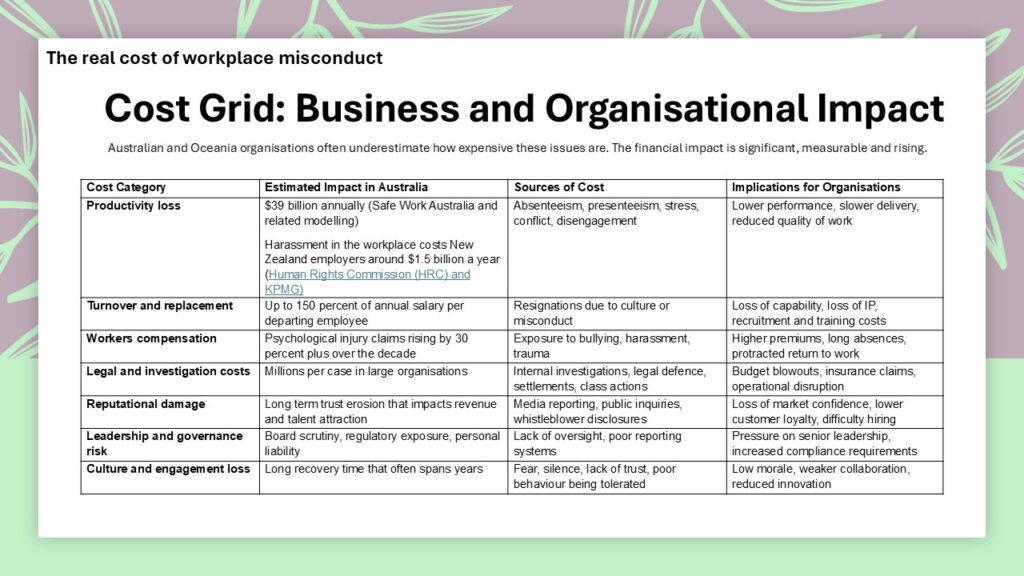
These costs show that ignoring misconduct is far more expensive than addressing it. The financial burden compounds over time and can quickly become a strategic risk.
What can Australian/Oceania organisations do now?
1. Make psychological safety a governance priority Boards should review workplace behaviour data the same way they review financial performance and risk. This requires regular, transparent reporting.
2. Build reporting systems employees trust Anonymous channels, independent investigations and trauma informed approaches help rebuild trust and show that the organisation takes concerns seriously.
3. Hold leaders accountable consistently Consequences must apply to senior leaders, not just frontline employees. Culture shifts when accountability is shared and visible.
4. Replace one off training with ongoing capability building Real culture change requires regular discussion, coaching, reflection and feedback aligned with organisational values.
5. Focus on vulnerable groups Strengthen support and oversight for workers who face higher risks due to status, power imbalance or employment conditions.
6. Increase the authority of HR and safety teams Equip them to act early, intervene confidently and operate free from pressure that protects reputations rather than people.
7. Prioritise transparency Share outcomes where possible, publish aggregated data and normalise conversations about culture. Silence protects misconduct. Openness strengthens trust.
Australia, for example, has the frameworks and the evidence. The challenge now is to shift from awareness to accountability and from policy to practice.
What will it take for Australian (and those in the region) workplaces to close the gap between what is promised and what people actually experience, and what changes would help you feel safer speaking up?
I would love to hear your views.